Child & Adolescent Psychology
Sometimes you can tell your child is struggling long before you can explain why. Support for children and teenagers across Melbourne, and for the parents who noticed first.
Home / Child & Adolescent Psychology
Tailored psychological care built around your child and family.
Australian children and adolescents experience a mental health condition
of lifetime mental health challenges begin before age fourteen
young Australians experience significant anxiety impacting daily school routines
of parents seek professional guidance during major developmental transitions
Sources: Australian Bureau of Statistics (ABS), Australian Institute of Health and Welfare (AIHW).
Somewhere to start
Not every family arrives knowing what the problem is. Often there is only a sense that something has shifted — a child who used to bounce into school and now doesn’t, a teenager who has gone quiet, a house where everyone is walking on eggshells. You do not need a diagnosis, a referral or the right words to book an appointment. Working out what is going on is part of the job, not a prerequisite for it. Plenty of families aren’t sure which of our services they need when they first call, and the answer usually becomes clear after one good conversation.
Not every family arrives knowing what the problem is.
Often there is only a sense that something has shifted — a child who used to bounce into school, a teenager who has gone quiet, or a home walking on eggshells.
What to expect at the start:
- No diagnosis or referral required to book
- No need to have the “right words” ready
- Working out what is going on is part of our job
- Guidance on which service fits best after one initial chat

Things parents raise
The reasons families get in touch are wider than any list we could put on a page. Friendships that have fallen apart. Grief, a separation, or a frightening event the family is still absorbing. Perfectionism that looks like diligence from a distance and costs a great deal up close. Anger that arrives faster than anyone can catch it. A child who seems fine everywhere except home, or fine at home and nowhere else. Sometimes a teacher raised it first. Sometimes nothing has happened at all and your child simply seems less themselves than they used to be, and you cannot say why.
The reasons families reach out are broader than any list we could put on a page.
Common reasons parents contact us:
- Friendship issues: Social dynamics or friendships falling apart
- Life changes: Absorbing grief, family separation, or difficult events
- Perfectionism: High diligence that creates hidden anxiety
- Emotional bursts: Sudden anger that arrives faster than anyone can catch
- Setting contrasts: A child fine at school but struggling at home (or vice versa)
Sometimes a teacher raises it first, and sometimes a child simply seems less like themselves.
Meeting your family
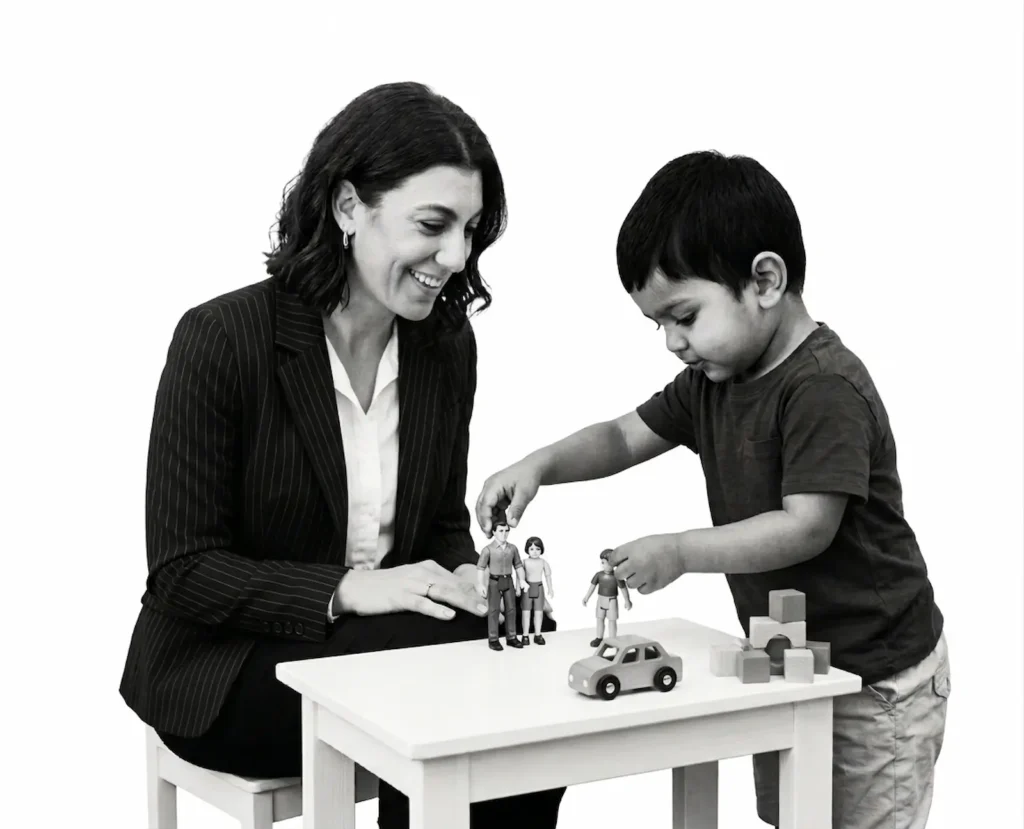
We start with time for you as parents, because you have watched this unfold and you know things your child cannot yet explain. Then we spend time with your child. Younger ones tend to show us through play, drawing and stories long before they can put any of it into sentences. Teenagers usually want to be spoken to directly and without an audience, so we make room for that. What we do next depends entirely on your child, and we will explain our thinking rather than ask you to take it on trust. With your consent we can speak with their school.
We build a supportive environment tailored to your child’s developmental stage.
Our clinical intake process:
- Parent session first: Gathering your insights and perspective
- Child session: Paced comfortably around their communication style
- Younger children: Expressing thoughts through play, drawing, and stories
- Teenagers: Spoken to directly with space for private, open dialogue
- School collaboration: Connecting with teachers, strictly with your consent
We always explain our clinical thinking rather than asking you to take things on trust.


How progress looks
Change in children rarely announces itself. It usually shows up first in small ordinary things — a morning that goes smoothly, a friendship picked back up, a sentence said out loud that could not have been said before. We agree with you early on what a better term would actually look like, so that we are measuring against something real rather than against a vague feeling. Some families need only a short block of sessions. Others come back at different stages as their child grows. We review honestly with you, including when something is not working and the approach needs to change.
Progress in children rarely announces itself — it shows up first in small, ordinary moments.
Signs of meaningful change:
- Smoother morning routines at home
- Re-engaging with friends and hobbies
- Expressing thoughts that felt previously impossible to say
We set clear, practical goals early on so we measure against real progress. We review honestly with you as we go, adapting our approach whenever something isn’t working.
How We Help You
Reach out for an initial chat. We’ll listen to what you’re seeing at home, answer your questions, and guide you on the best way forward.
We meet with you first as parents to map out their history, then begin engaging sessions tailored to your child’s age, interests, and needs.
We work collaboratively using evidence-informed strategies, regularly reviewing progress together to ensure your child feels supported every step of the way.

Frequently Asked Questions
Do I need a referral to book?
No. You can contact us and book directly.
If you’d like to claim a Medicare rebate, you’ll need a Mental Health Care Plan from your GP, paediatrician or psychiatrist first. We’re happy to explain how that works if you’re not sure where to start.
My child doesn't have a diagnosis. Is that a problem?
Not at all, and many of the children we see don’t have one. We work with what’s actually happening for your child, and support doesn’t have to wait on a diagnosis.
If it turns out an assessment would help clarify things, we’ll say so — but that’s a decision made with you, not a hoop to jump through first.
I'm not sure which of your services we need.
That’s a common place to start, and it isn’t something you need to work out before getting in touch. We’ll sort it out together in the first conversation.
You won’t have to explain it all again from the beginning either — what you tell us at the start carries through into whatever the work turns out to be.
What ages do you work with?
Children and teenagers up to age eighteen, and their parents. How the work runs changes a great deal across that range — a seven-year-old and a sixteen-year-old need very different appointments.
Does my child have to talk?
No, and plenty don’t at first. Younger children usually get there through play, drawing and stories. Teenagers often open up once they’ve decided for themselves that it’s worth it, and that happens in their own time rather than ours.
We won’t push your child to talk before they’re ready. Pushing tends to buy silence rather than trust.
How many sessions will we need?
It varies. Some families come for a short block and feel steadier; others continue longer, particularly when there’s a lot going on at once.
We review with you as we go rather than committing you to an open-ended course of appointments.
Can you talk to my child's school?
Yes, with your consent. Schools see a version of your child that home doesn’t, and consistency between the two makes a real difference. Where it would help, we can also observe in the classroom.
Do you offer telehealth?
Yes. Parent sessions work particularly well by video, and it helps families who’d otherwise be travelling a distance.
Younger children generally do better in the room, so we’ll talk through what mix suits your family.
How soon could we be seen?
Get in touch and we’ll tell you what’s actually available rather than a general answer. Availability moves through the year, so it’s always worth asking.
Do you work with NDIS participants?
Yes — we see children whose plans are self-managed or plan-managed, and we can invoice your plan manager directly.
Let's start the Conversation
- For urgent support, please contact Kids Helpline on 1800 55 1800 or Lifeline on 13 11 14. This form isn't monitored 24/7.
- Melbourne & Mornington Peninsula
- Telehealth Available Australia-Wide
- 1300 233 211
- Send us a message via form